Translate this page:
You can translate the content of this page by selecting a language in the select box.
Share this link!
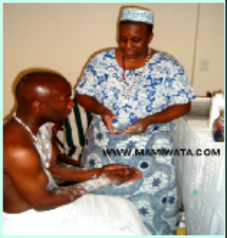
Above: Mama Zogbé initiating African-American man to Mami Wata.
The prevailing literature tends to exclude African-Americans without realizing that they are even more connected to African spirits because of the devastation of slavery in which Mami also suffered. Far too many young black men are suffering mental disorders especially schizophrenia, starting as young as 13 yrs., because the source of their problem is Mami.

New African-American initiate born to Mami Wata. African males serving as priests, mystics, prophets, philosophers, musicians, kings, etc., have been the spouses of Mami since time immemorial.
“The Mami Wata, Mama Tchamba and the Vodou spirits dominate in West Africa, where they honor the many Africans who were enslaved in the New World”.
-Mama Zogbé, USA
By far, one of the most devastating and little written about aspects of slavery in America, was the active suppression and demonization of African religions. The loss of crucial sacred knowledge of the African deities and how they manifest at birth (or any stage of maturation) in the Diaspora, was no longer relied upon or respected by “educated blacks,” desperate to disconnect themselves from what they had been conditioned to believe were “barbaric and primitive African practices.”
As a result, the crucial ritual knowledge needed to reconnect the Diaspora to their deities was lost, greatly contributing to the all pervasive bio-spiritual/psycho-emotional deprivation and social malaise, (i.e. depression, melancholy, schizophrenia, suicide, criminal behavior etc..) that is found in many African-American communities today.
Worse, the extreme sense of cultural and spiritual alienation in which mainstreamed (assimilated) middle-class blacks are experiencing in spite of college degrees, and impressive resumes, expresses a great need to critically examine the prevailing myths concerning the religions of their ancestors, and why they had tenaciously clung to them in spite of the specter of ostracism, mockery and death.
Black Americans are born with many spirits that are still connected with their African ancestors. In Togo, West Africa, Mami Wata and Mama Tchamba are strongly connected with the enslaved Africans that were brought over to the New World.
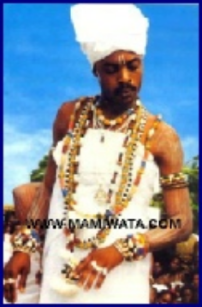
Above: Togolese Mami initiate in full regalia. Mami Wata as the Divine African Mother/God/dess has been worshiped and celebrated around the world for thousands of years.
From Egypt as Isis, in Asia Minor (Ephesus), as Sibyl (Cybele), in Greece as Rhea, Hekate and Artemis, and in Rome as the great Magna Mater, Parvati, amongst her other holy names.
African men maintain a unique distinction amongst the world’s men as being her first and most desired votaries. Prior to the rise of African patriarchy, for more than 6,000 years, African men were originally nurtured under the yoke of matriarchy.
(Photo: © of Hazoumeè& Lionel H.)
Many Africans brought and enslaved in the New World already descend from long lineages of Tchamba and Mami spirits, but are unaware of this based on past and current anthropological literature, which tends to omit them.
Many of these Mami Wata deities are directly connected with the pre-Mohammedan Awussa (Muslim) ancestral lineages that date back more than 1000 years.
In fact, the experience of slavery makes the Diaspora more connected, because of whom Mami and Mama Tchamba represent in Africa and in the lineages that were broken and disrupted.
Black Women are more likely to seek out Mami intuitively knowing their ancestral connection with these ancient deities. However, Black Men who are traditionally initiated to Mami as a balance of their masculine force, are often unaware of their ancestral matrilineal heritage, and pressure is often forced on them to conform to a false machismo not characteristic of ancient African philosophy or culture.
In America, when Black Men are born to Mami Wata, they are often at a loss to explain their spiritual sufferings, and some tend to self-medicate with illicit drugs, alcohol or other dissociative means. Some even resort to crime, or exhibit such psychotic behavior that they are eventually institutionalized.
The often openly racist condemnation of African religions and culture lead many Black men at the mercy of Western conventional medicines and spiritual agencies who understand nothing of their African-spiritual components. This fact is clearly borne out in a little known report written by the then leading American psychiatrist Ronald Wintrob, who was sent on a special mission to Liberia by the United States government. During his mission, Wintrob, suddenly noticed an unusual number of [militant] African-American men, who had previously expatriated to the country, seeking psychiatric treatment. They reported developing severe symptoms, of what he described as “psychosis,” depression, and of experiencing erotic dreams involving a mulatto or “white skinned” female. After examining these men, Dr. Wintrob, reached the following prognosis:
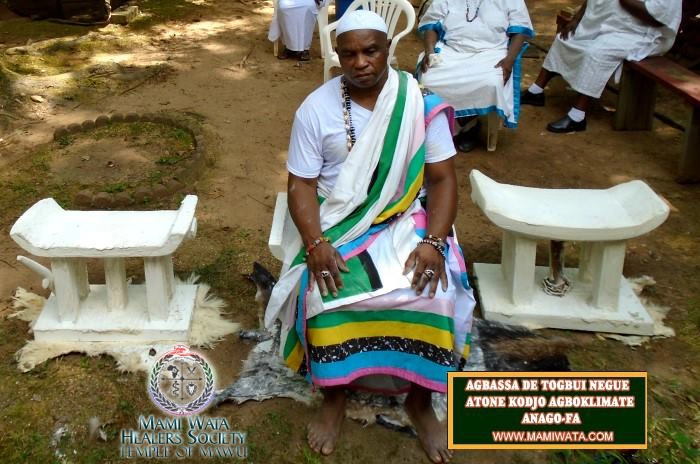
African American men are favored by Mami, because of the level of suffering their spirits have endured in the West.
"Suffering" is considered a virtue by Mami because it prefigures greatly in spiritual growth.
There are many roads to Mami Wata, from the "prophet", to the Mystic, to the "savior kings", which began in Ancient Africa.
“ . . . Finally there is the concept of the desired but prohibited object, the white female. . . .that the spirit is called “Mammy” Water. . . The nature of this fusion of fantasies would demand that their meaning remain hidden from essential consciousness, and this might explain the operation of the denial mechanism in identifying Mammy Water as white-skinned rather than Negro. Dreams of sexual intercourse with her would indicate the break-through of incestuous impulses in a disguised form, and thus the gratification of repressed infantile genital wishes.” (Wintrob, Ronald M., M.D. "Mammy Water: Folk Beliefs and Psychotic Elaborations in Liberia," Canadian Psychiatric Association Journal (1970):15 (2)April: 143-157.
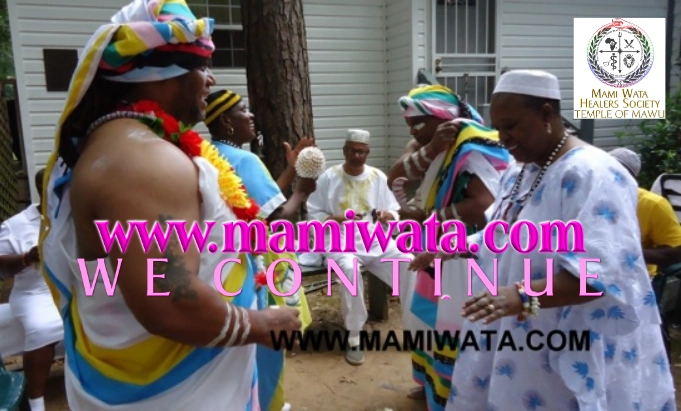
Mama Zogbe, in joyous celebration (rt).
"Mami Wata has always been in the spirit/souls of the Diaspora lineages. We must not wait for others to acknowledge this. We must claim and celebrate all of our spirits." -Mama Zogbe
Wintrob then, as western conventional treatment, and so many spiritual and holistic practitioners do today, never recognized the bio-spiritual, African ancestral connection between these Black men expatriating to a country in which Mami Wata worship is strong, and where priestesses were available to assist them. Because western culture has historically relegated African spirit, cosmology and religion to mere “childlike superstition,” Wintrob failed at a unique opportunity to discover that “race” as it is defined in African religion and culture, has a symbolical significance as representing the world of spirit. He further failed to recognize one of Mami‘s manifestational behaviors of spiritual psychosis (“acting out”) exhibited by these men, so that they could be led to the proper place for spiritual assistance. Worst still, because of the history in the West of denying the spiritual essence of African people, Wintrob failed to recognize one of the most universal signs chronicled in religious history across the world by the ancient prophetesses and prophets when “seized by the spirit;” which is what Mami Wata is known for in African ecclesiastical culture, since time immemorial. Unfortunately, Wintrob makes no mention if whether these black American men were ever successful in seeking out a Mami Wata priestess These men more than likely never received proper ceremony, and probably continued to suffer needlessly, most descending into some form of mild or severe mental (spiritual) illness.
The need for more qualified and trained African-American clergy in African religion and ritual is critical. The need to author books that will aid in establishing and grounding the ecclesiastical, philosophical, social and cultural aspects of African spiritual practices conjoined with the African-American cultural experience is extremely important. A three dimensional, historical and descriptive idea of whom these ancient deities are from an African-American perspective, and how they relate to the Diaspora is a step in that direction.